Momentum. A small site about one idea: what you set in motion carries on.
Every motion begins held still.
Let go. Mass meets velocity.
The force passes through what never seems to move.
A small push here lifts something far away.
Momentum. What you set in motion carries on.
THE PHYSICS
The quantity of motion.
Physics gives momentum a precise meaning: mass times velocity. A small thing moving fast can carry as much as a heavy thing moving slowly. And because velocity has direction, momentum does too. Where you are going counts as much as how fast.
In classical mechanics, knowing both the position and momentum at a given moment allows the equations of motion to determine what happens next.
A tiny change in a ball's initial position or momentum could eventually send it along a very different path if it moves through a complex system, such as a pinball machine or a turbulent atmosphere.
So, if two otherwise identical systems differ by only a tiny amount of momentum, their future paths may eventually diverge dramatically.
- p
- momentum, kg·m/s
- m
- mass, kg
- v
- velocity, m/s
Force is the rate at which momentum changes. Newton wrote his second law that way first: F = dp/dt.

IN A LIFE
The Power of Mental Momentum
In ordinary language, momentum means forward drive. It describes a growing tendency for events to continue or accelerate.
Habitual tendencies obey the same law. The hardest part is starting. The first rep is the hardest one. Once you get going, you can do more than you planned. And the reverse is true too: one missed day turns into a month faster than anyone expects.
A repeated thought, emotion, or behavior can develop psychological “momentum”: it becomes easier to continue in the same direction. A new influence—attention, understanding, restraint, compassion, or a changed environment—can alter that direction. That is a metaphorical use of momentum, not a claim that thoughts literally possess mechanical momentum.
TRY IT
Pull. Release.
Grab the last sphere. Pull it back. Let go.
THE CHAOS
Chaos Theory
Chaos theory is the study of deterministic, nonlinear dynamical systems whose behavior is aperiodic and exhibits sensitive dependence on initial conditions—meaning that arbitrarily small differences in the starting state can eventually produce substantially different outcomes. Such systems follow precise rules, but their long-term behavior can be practically unpredictable. (ref: https://plato.stanford.edu/entries/chaos/)
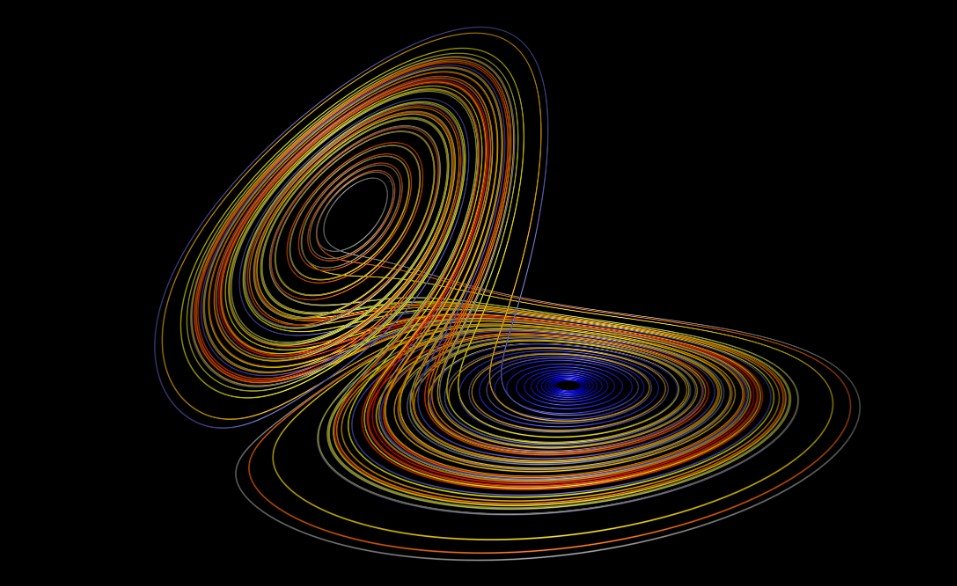
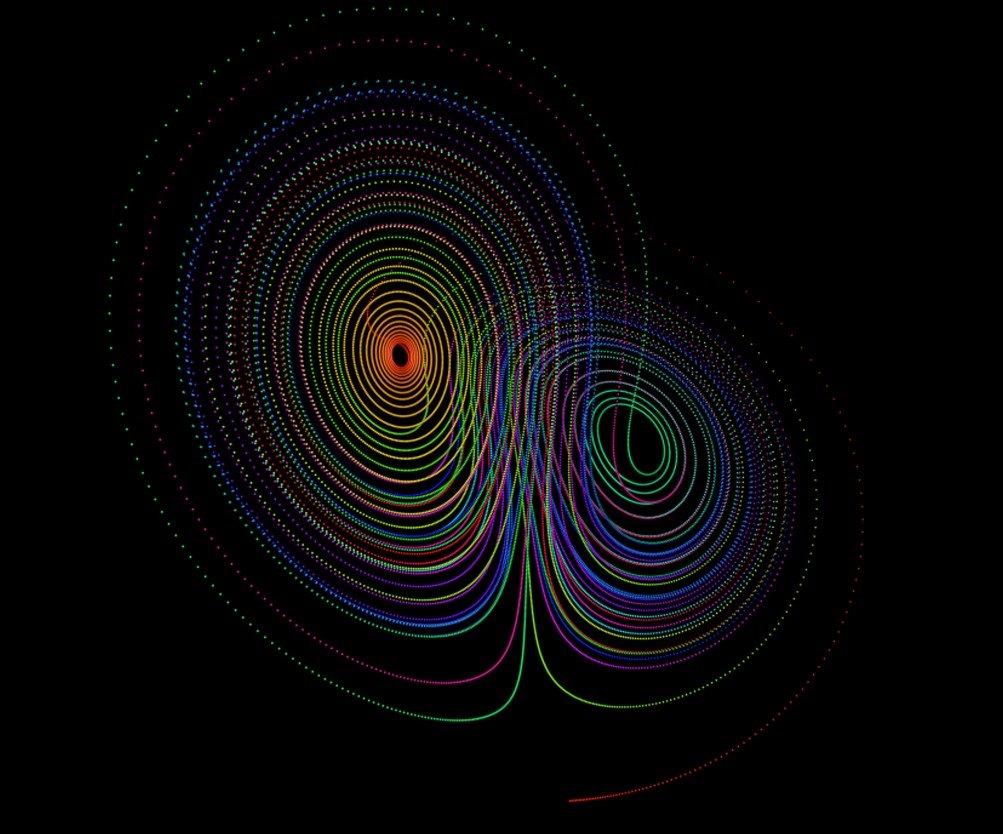
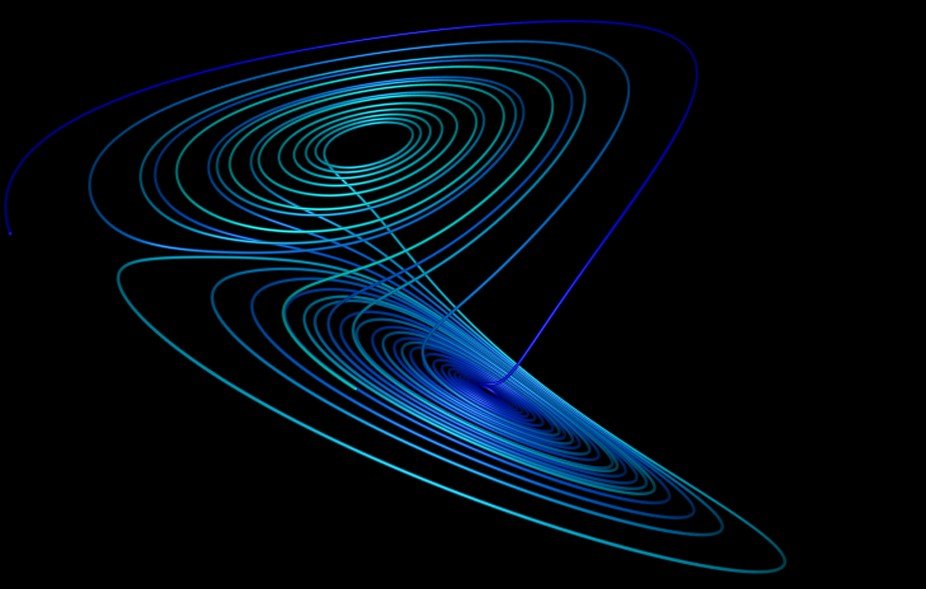
Edward N. Lorenz first observed this phenomenon in 1961 while performing numerical calculations with a simplified weather model. However, the formal publication most closely associated with his discovery was published in 1963 “Deterministic Nonperiodic Flow.” The paper demonstrated that deterministic nonlinear systems can produce aperiodic behavior that is highly sensitive to initial conditions, forming the foundation of modern chaos theory. (ref: https://pmc.ncbi.nlm.nih.gov/articles/PMC3202497/)
HONEST QUESTIONS
Asked, and answered straight.
A small action does not always produce a dramatic result. Its effect depends on the system, the timing, and the conditions surrounding it. In complex systems, however, a small change can sometimes be amplified through feedback, habits, and interconnected events, while at other times it may simply fade away.
The same principle can be understood in human behavior. A small intention can lead to a small action; repeated actions can strengthen a habit; habits influence how we perceive situations and make future choices; and those choices can gradually shape our relationships and circumstances. The process is not fixed, because a new action or change in conditions can interrupt an established pattern.
Therefore, the important lesson is not that every small action creates a huge consequence, but that small changes at the right moment can redirect an unfolding pattern. Paying attention to our intentions, actions, and repeated habits gives us an opportunity to change the direction of that pattern before it becomes deeply established.
Physics gives an honest answer. Changing momentum takes force applied over time, and an object at rest has nothing working in its favor: every bit of motion must come from the effort itself. At the first step the force is all yours and the momentum is still zero. Only after motion begins does motion start to help.
Behavior obeys the same law. A repeated thought, emotion, or behavior develops psychological momentum, and before the first step that momentum belongs to the old pattern: the habits, perceptions, and circumstances already in motion. Taking the first step is not starting from zero. It is turning against a system that is already moving in another direction, which is why the beginning feels heavier than any step that follows.
The encouraging part is that the same sensitivity works in your favor. A habitual pattern interrupted even slightly creates an openness that short-circuits the usual behavior, and a small act at the right moment can redirect the whole process. The first step does not need to be large. It needs to exist. Each repetition after it adds to a new momentum, until what was hardest becomes what carries you.
Not necessarily. A nonlinear brain system could, in principle, be highly sensitive to very small disturbances. If a microscopic event were capable of influencing whether a neuron fired, and that difference were subsequently amplified through neural dynamics, the brain might develop along a different trajectory and eventually produce a different choice.
But sensitivity is not the same as freedom. A chaotic system can be extremely difficult to predict while still being deterministic: its later states may follow from its earlier state according to the system's dynamics. Conversely, if genuine indeterminacy at the microscopic level affects brain activity, randomness alone does not create free will either. The deeper question is whether a conscious agent can somehow use, control, or appropriately integrate such indeterminacy into deliberate choice.
There is also an important biological constraint. The brain contains enormous numbers of interconnected neurons and substantial redundancy, so it cannot simply be assumed that a change in one neuron will propagate through the entire system and alter a person's eventual decision. Whether such amplification actually occurs to a meaningful degree is an empirical question.
Thus, the most careful conclusion is: small events may influence the trajectory of brain activity, but neither sensitivity nor indeterminacy by itself explains consciousness or establishes free will. The unresolved issue is whether the complex dynamics of the brain merely produce unpredictable choices—or whether they provide a genuine mechanism through which a conscious agent can exercise agency.
THE NEXT MOMENT
The important question therefore isn't simply:
“Am I moving?”
but:
“What direction am I reinforcing?”
- 01Right View
- 02Right Intention
- 03Right Speech
- 04Right Action
- 05Right Livelihood
- 06Right Effort
- 07Right Mindfulness
- 08Right Concentration
You don't always have to change your life. Sometimes you only need to change the next moment.
A pause.
A breath.
A different thought.
A different word.
A moment of awareness.
A different response.
The future is not only something we arrive at—it is something we continuously influence through the moments we are living now.
Every moment is an opportunity to interrupt an old pattern and create a different direction.
SAY HELLO
Send a thought.
This site is one idea shared. If it moved something, or if you see it differently, tell me.
WRITE TOhello@themomentumidea.com
Notice the moment. Change the pattern. Shape what comes next.